
Selling macros
Once you are an , any listing you publish can be paid instead of free. This page is the money side of that: what you set, what you keep, and when you can actually have it.
The authoritative version of all of this is the Creator Agreement, which you accepted when you applied and can re-read in full from the app. Where this page and the Agreement disagree, the Agreement wins.
Pricing
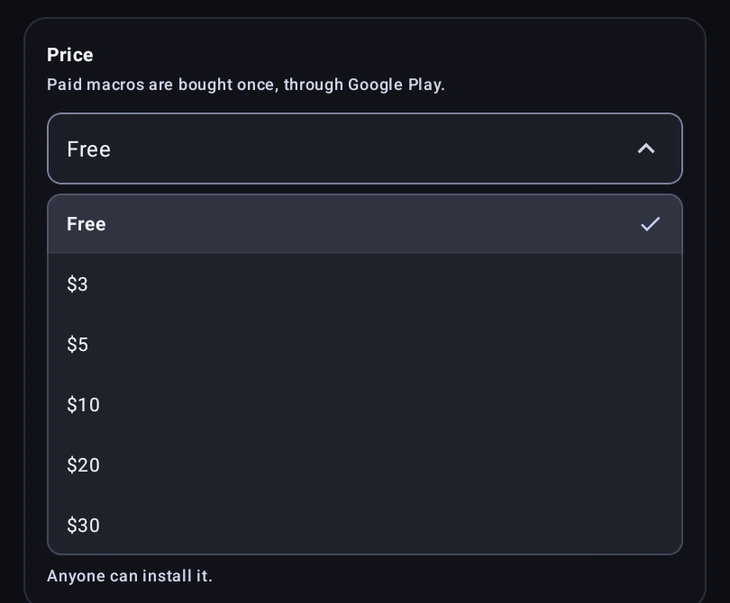
A listing is Free, or one of five fixed price tiers running from about 3 to 30 US dollars. You pick a tier, not an arbitrary number, and buyers see it converted into their own currency by Google Play.
There is no 1 dollar tier on purpose. At a 55% share and a 50 dollar payout minimum, a 1 dollar macro would need about 91 sales before you could be paid anything at all.
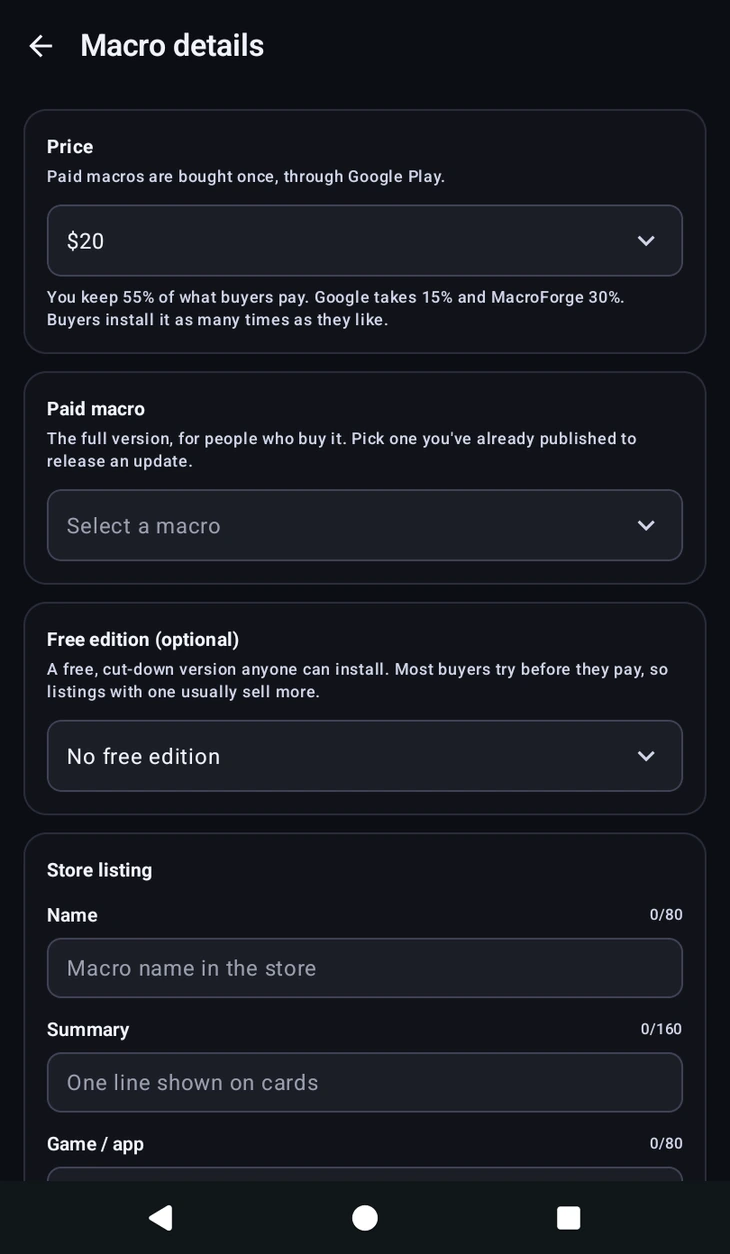
Paid macros are bought once. There are no subscriptions, and a buyer can install what they bought as many times as they like.
The free edition
A paid listing can carry a second, free macro alongside it. It has to be a genuinely different macro from the paid one, and it has to work on its own terms rather than being a demo that stops halfway.
It is optional, and worth doing anyway. Most people will not pay for automation they have not seen run, and listings with a free edition tend to sell better than listings without one. The paid macro cannot also be its own free edition, so you are building two things.
What you keep
Your share is 55% of what the buyer pays. Google takes roughly 15% as its store fee, and MacroForge keeps the rest for hosting, review, moderation and support.
If Google changes its fee, your 55% does not move; the difference comes out of our share, not yours.
Google Play is the seller of record and processes every payment. We never touch your buyer's money directly and do not store card details. Your share is worked out per sale and recorded in a ledger you can see in the creator console, and that ledger is append-only, so a correction appears as its own entry rather than quietly editing an old one.
When a sale becomes payable
A sale becomes available on the 15th of the month after the month it was made in. Every sale in March becomes available on 15 April.
Two reasons for the wait, and both are real rather than administrative. A buyer can get a refund or reverse a charge after the fact, and money that has already left cannot be clawed back. And Google settles a month's sales to us partway through the following month, so that is genuinely the first point at which the money behind your sale has reached us.
Until then it shows as on hold in your analytics rather than as available.
Getting paid
Once your available balance reaches 50 USD, Get paid in the creator console opens the payout form. Payouts are made monthly, by hand.
- Method: PayPal, bank transfer, or Wise.
- Send it to: the email on your PayPal or Wise account, or your IBAN or account number.
- Full name and Country, as they appear on the account receiving the money.
Filing a request does not move anything by itself, and your balance does not drop when you file it. A person reviews it, sends the payment, and the balance changes then. You may only have one open request at a time, and the history below the form shows every earlier one as Waiting, Paid or Declined, with the moderator's note attached.
For your own safety a request cannot be paid during its first 24 hours, and you are notified the moment one is filed. If you ever get that notification without having asked for a payout, contact support immediately, it means someone else is in your account.
Before a first payout we may need identity and tax details. You are responsible for your own taxes on what you earn here; we do not withhold on your behalf unless the law requires it. Payment methods depend on your country and we cannot reach everywhere, if none of ours works for you, get in touch, and your balance stays on your account in the meantime.
Refunds
If a buyer is refunded or reverses a charge, that amount comes off your balance, whether or not it had become available. If it was already paid out, it is deducted from future earnings, and your balance can read negative until it is recovered.
We can also hold a payout while we look into suspected fraud or artificial sales, and will not pay for sales we conclude were not real.
If you stop
You can stop publishing whenever you like and ask us to remove your listings. People who already bought a paid listing keep access to what they bought, and your right to be paid for completed, non-refunded sales survives. Your balance does not expire.